TECHNICAL VALIDATION

ServiceNow AI Control Tower

Achieving Positive AI Outcomes With Necessary Governance and Control

By Alex Arcilla, Principal Analyst – Validation Services
Omdia
JANUARY 2026

Introduction

This Omdia Technical Validation documents our evaluation of ServiceNow AI Control Tower, an enterprise-ready solution for tracking and monitoring AI projects throughout their lifecycles with the goal of optimizing business outcomes. Through guided demonstrations, we validate how this solution can help to track and deliver the business value that organizations strive to extract from their AI initiatives while imparting the governance and control required for operating responsible AI.

Background

Organizations are riding the wave of AI to accelerate the achievement of their business objectives, such as improving operational efficiency and the customer experience, increasing speed of product innovation, and creating market differentiation. Indeed, research from Enterprise Strategy Group (now Omdia) found that almost all organizations have already made moderate to significant investments in AI with dedicated budgets and teams, focusing on generative and agentic AI.
Yet, as significant AI investments continue, concerns arise on whether the AI systems deployed can realize the return on investment (ROI), which is widely anticipated. As new use cases and development approaches emerge, Omdia research found that organizations can struggle to see value from their AI investments as quickly as desired. In fact, over a fifth (21%) of organizations have taken a year or more to see this value.
While selecting the most appropriate AI use case can significantly determine how much value can be realized, one factor hindering how quickly organizations can recognize AI’s value is the lack of alignment of clear business objectives against specific AI initiatives and projects. In the race to implement AI into their daily operations, organizations’ business cases should be clearly articulated and subsequently measured before committing any investment; without establishing clear key performance indicators (KPIs), quantifying the value derived becomes difficult and does not clearly indicate how to direct and prioritize future investments.
At the same time, organizations must also check that the proper governance and controls are in place without delaying ongoing AI-related efforts. This becomes especially critical when scaling and expanding the scope of AI initiatives. Should ambitious teams focus on being first to market and gaining some short-term success, compliance might be perceived as an inconvenience that can be addressed later.
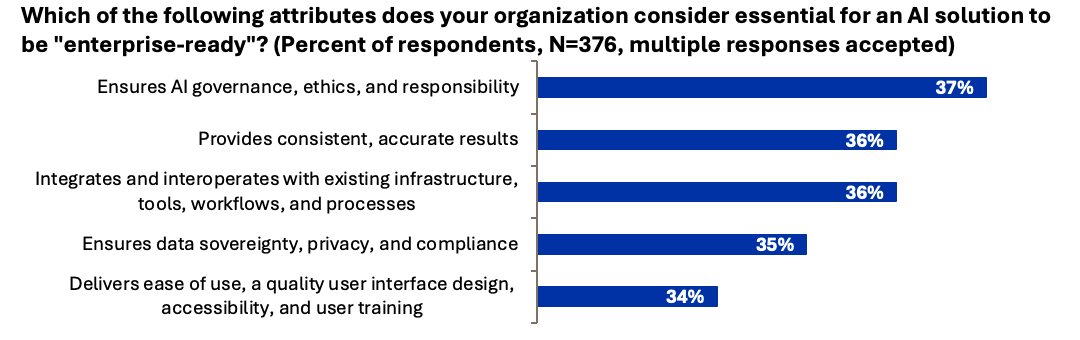
Supporting both scalability and compliance typically calls for an “enterprise-ready” solution. And while organizations use different criteria to evaluate whether a solution is “enterprise-ready,” ensuring AI governance, ethics, and responsibility was found to be the most commonly cited feature they considered essential to satisfy (see Figure 1).
Figure 1. Top 5 Attributes for AI Projects to Be Considered ‘Enterprise-ready’
Source: Omdia

In this burgeoning area of AI—specifically generative AI and autonomous AI—the phrase “with great power comes great responsibility” must apply. What does this mean? Organizations that wish to continue using and scaling AI must provide evidence of how their initiatives deliver business value and align with KPIs. Simultaneously, scaling AI also demands that governance and compliance are in place at every step of development and implementation to ultimately build the trust, and subsequently, the adoption of AI within and outside of the organization.

ServiceNow AI Control Tower

Built on the ServiceNow platform, ServiceNow AI Control Tower is an enterprise-level solution designed with a dual purpose: to ensure governance across AI initiatives and track how well these initiatives perform against clearly defined business objectives. This solution enables organizations to track AI projects—traditional (e.g., machine learning), generative, agentic—throughout their lifecycles (i.e., conception, build and deploy, and post-implementation). With ServiceNow AI Control Tower, organizations gain visibility into current project status and performance against business-oriented KPIs while managing overall security and compliance risk.

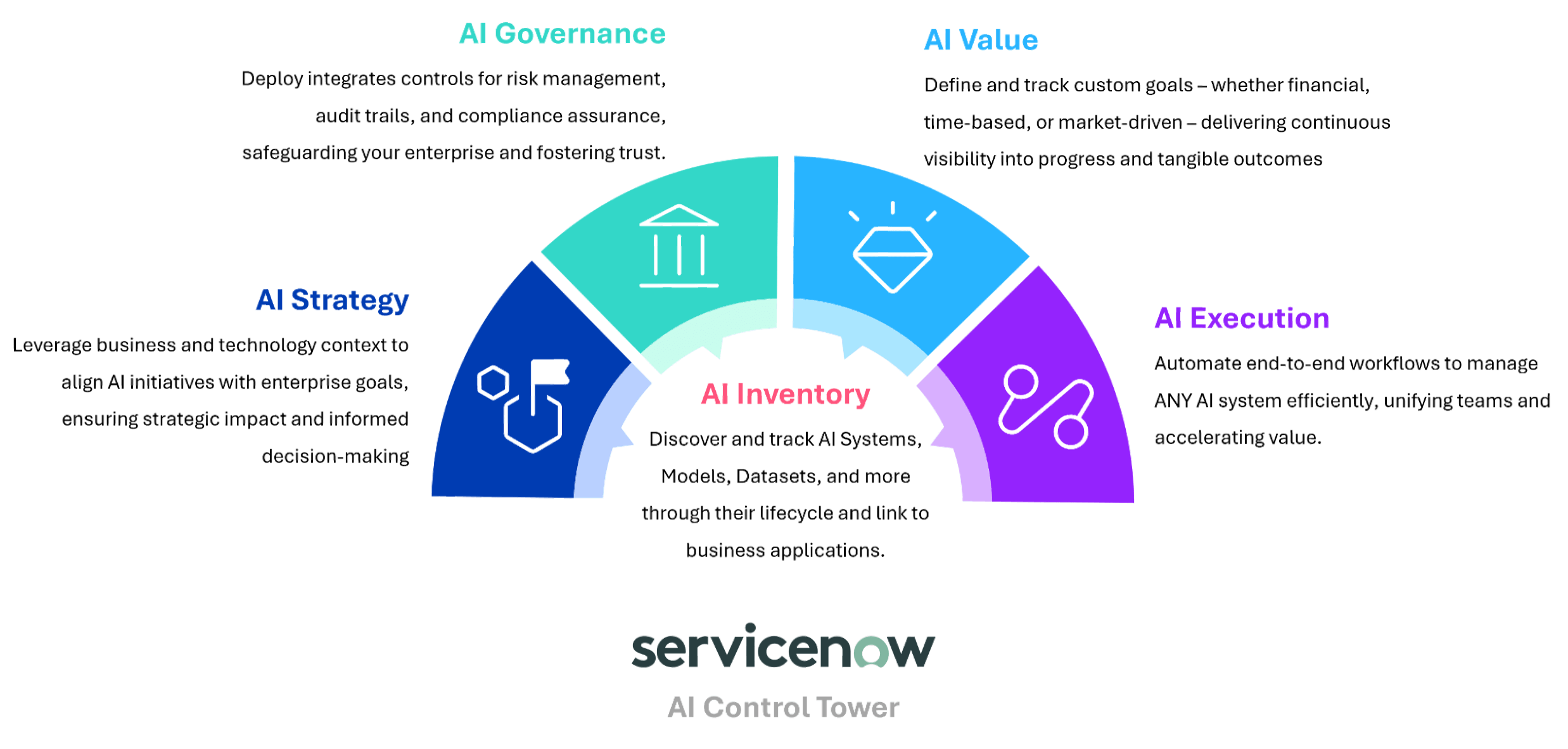
Organizations can obtain visibility and control over four critical areas when conceptualizing, deploying, and managing AI projects (see Figure 2):
• Aligning AI initiatives with company-wide strategy. By tying specific AI investments to strategic business objectives, organizations can prioritize, plan, track, and map where and when the ROI is occurring. To maximize the value extracted from AI resources, organizations can also use ServiceNow AI Control Tower to align AI initiatives to the organization’s technology and business architecture so that resource redundancy is minimized.
• Facilitating collaboration when executing AI projects. Once an AI project is submitted, ServiceNow AI Control Tower supports the creation of the business case, then assigns tasks across the relevant functions to ensure that buy-in and approvals are obtained. ServiceNow AI Control Tower encourages collaboration amongst cross-functional groups (e.g., product, legal, compliance, architecture) with automated and integrated workflows governing the AI project lifecycle.
• Decreasing business risk with appropriate governance and control. To help organizations in driving responsible AI—AI that addresses concerns about the data used and the results produced (e.g., Are the data and their sources trusted? Are the results correct and consistent? Is the data complete and secured?)—ServiceNow AI Control Tower supports organizations in strengthening organizational responsibility for delivered AI that end users can trust. This solution component employs ServiceNow’s existing integrated risk management products that enables continuous compliance monitoring while removing the typical governance roadblocks that can occur (e.g., learning how to adhere to new compliance regulations).
• Visualizing the value gained from AI initiatives. Once an AI project is in production, organizations can create and track key metrics—financial, time-based, market-driven—that demonstrate the tangible value delivered over time. With ServiceNow AI Control Tower, organizations can continuously measure AI initiative performance and business outcomes against strategic objectives, closing the loop from strategy to value. Organizations can also visualize and report usage of these AI initiatives in the field and monitor the performance of their AI agent connections to identify bottlenecks and issues.
Figure 2. ServiceNow AI Control Tower
Source: ServiceNow and Omdia

As part of the self-service model enabled by ServiceNow AI Control Tower, teams can onboard new AI models and use cases by completing online intake forms. Once onboarded, this solution immediately checks to apply the proper control and governance throughout the project’s lifecycle. ServiceNow AI Control Tower can also evaluate compliance of AI projects according to the NIST AI Risk Management Framework and the EU AI Act. Customers can also input other controls as they see fit.
ServiceNow AI Control Tower brings these capabilities into one integrated platform, removing the need for organizations to purchase, learn, and integrate multiple point solutions to achieve the visibility and control over their AI assets and projects. Organizations no longer need to work with multiple point products to achieve the collaboration, visibility, and control needed to achieve success.

Omdia Technical Validation

Omdia validated how ServiceNow AI Control Tower can provide the visibility and control over new and ongoing AI projects. We specifically evaluated how organizations can align AI initiatives with company-wide strategy, facilitating cross-functional collaboration within AI projects, decreasing compliance risk, and visualizing the value gained from AI initiatives.

A foundational element of ServiceNow AI Control Tower is the ServiceNow Configuration Management Database (CMDB), previously shown in Figure 2. This generates the system of record for all AI projects within the organization. This same CMDB has supported ServiceNow customers in automatically generating IT asset inventories and existing relationships amongst those assets; for ServiceNow AI Control Tower, this CMDB maintains AI asset inventory and their relationships and dependencies. By leveraging the CMDB, ServiceNow AI Control Tower generates the views that support the capabilities Omdia validated.
Service AI Control Tower can discover AI systems, models, and data deployed in public cloud environments by employing prebuilt integrations with AWS Bedrock, Azure AI Foundry, and Microsoft Copilot Studio, with planned integrations for other systems, such as Google Cloud. Out-of-the-box connectors are included for onboarding these project types. For AI projects supported by other third-party solutions, teams can utilize APIs to integrate the related assets into the CMDB.

Aligning AI Initiatives With Company-wide Strategy

The scrutiny over increasing amounts of AI investment demands that organizations tie AI projects to strategic business objectives and business cases, such as revenue generation and operational cost reduction. ServiceNow AI Control Tower enables organizations to map AI projects with specific business objectives and track KPIs to measure the value delivered.

Omdia Analysis

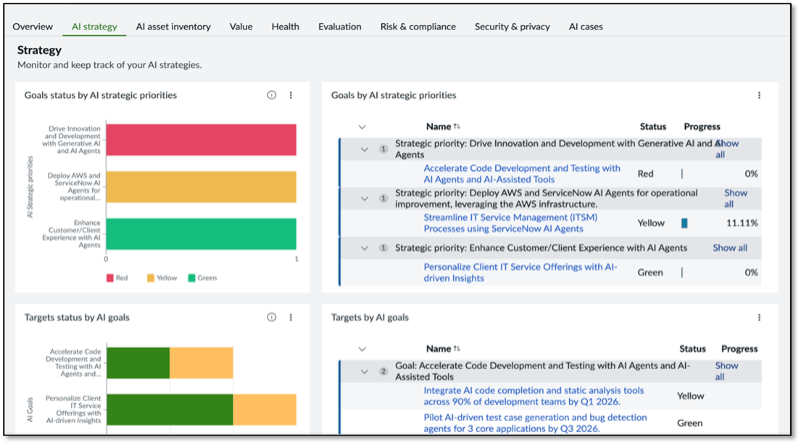
To evaluate how organizations can track the value that AI projects deliver with ServiceNow AI Control, Omdia first navigated to the “AI Strategy” tab. Using ServiceNow’s Strategic Portfolio Management capabilities, we saw how an organization links AI projects to strategic priorities and objectives and key metrics (OKRs), shown in Figure 3. The Strategic Portfolio Management capability also reveals projected vs. actual progress/status of these projects. Color coding notes overall project status, helping organizations instantly see projects requiring immediate attention so that progress remains on track.
Figure 3. Organizations Tying AI Initiatives With OKRs
Source: Omdia

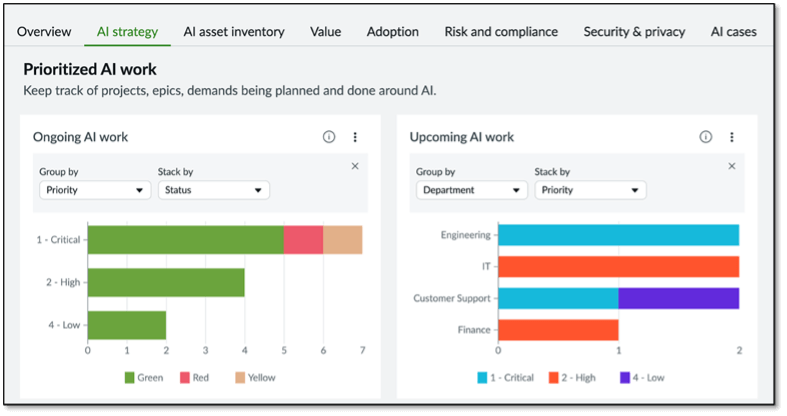
Omdia also observed that organizations can pivot into other views for assessing current status. As shown in Figure 4, ServiceNow AI Control Tower shows AI projects grouped by strategic priority and department. While ServiceNow supplies prioritization models out of the box, organizations can also input their own models, such as prioritization by committee. With this view, organizations can identify projects that need more attention to ensure that timely progress continues.
Figure 4. Revealing Overall AI Project Status and Work Priority
Source: Omdia

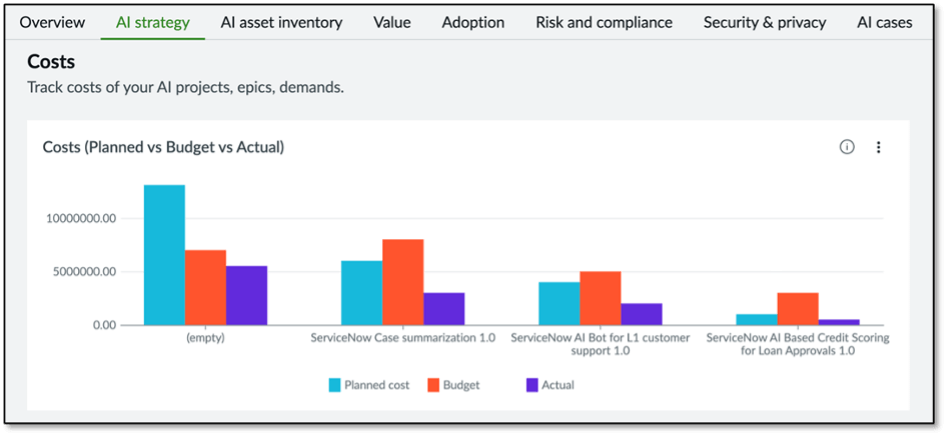
With AI Control Tower, organizations can also track and control costs. Figure 5 shows planned, budgeted, and actual costs to date by AI project.
Figure 5. Tracking Costs Across Ongoing AI Projects
Source: Omdia

As Omdia reviewed how ServiceNow AI Control Tower can track AI project status, we noted the importance of the CMDB in generating the AI asset inventory and dependencies between these assets, along with other relationships to the supporting technology and business architecture. The CMDB’s auto-discovery feature is key in creating these alternative project portfolio views, providing the breadth and depth of visibility that reveal potential issues impacting project completion. Omdia also observed that the different views can reveal dependencies across AI projects to avoid hindering progress of any individual effort.

Why This Matters

According to Omdia research, 38% of survey respondents stated that not establishing clear business objectives for AI initiatives was a top factor that most significantly delayed their organizations from seeing value from AI. While much enthusiasm surrounds the potential of AI, organizations must align their AI projects with established strategic business goals to increase the chances of delivering business value. Without considering and monitoring how an AI project achieves its business case, organizations ultimately cannot articulate how these projects helped the business, risking subsequent investment.

Omdia validated that ServiceNow AI Control Tower helps organizations link AI projects with established business objectives and track progress across different dimensions, such as criticality of issues encountered and costs incurred to date. By leveraging ServiceNow’s CMDB, organizations can automatically generate an AI asset inventory that feeds into various views of an organization’s AI project portfolio. Using these views, Omdia also validated that organizations gain the breadth and depth of visibility to ensure that the maximum value can be extracted from their AI projects.

Facilitating Collaboration for Onboarding and Deployment of AI Projects

As Omdia reviewed how ServiceNow AI Control Tower can track AI project status, we noted the importance of the CMDB in generating the AI asset inventory and dependencies between these assets, along with other relationships to the supporting technology and business architecture. The CMDB’s auto-discovery feature is key in creating these alternative project portfolio views, providing the breadth and depth of visibility that reveal potential issues impacting project completion. Omdia also observed that the different views can reveal dependencies across AI projects to avoid hindering progress of any individual effort.

Omdia Analysis

To evaluate how ServiceNow AI Control Tower fosters collaboration, Omdia considered a scenario in which an employee submits a new AI use case: AI-based credit scoring for loan approvals.

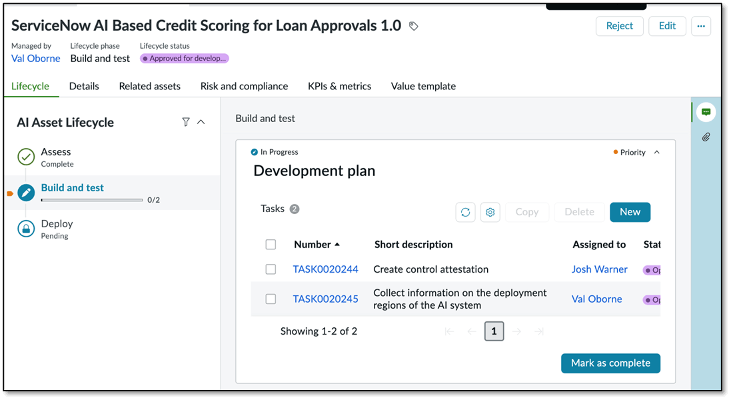
Before any project work begins, an intake form must be completed that describes the proposed project and related details such as the project owner (e.g., sales), supporting documentation, and the models and datasets to be used. When the request is submitted and recognized by ServiceNow AI Control Tower, the tasks to complete during the AI project lifecycle (i.e., Assess, Build and Test, Deploy) are automatically generated along with task owners and due dates (see Figure 6). This same process occurs when onboarding an existing AI project.

Figure 6. Use Case Request Submitted for Review – Task Assignment
Source: Omdia

Task owners, assigned by ServiceNow AI Control Tower, span multiple functions, such as product teams, business owners, go-to-market, technology architecture, finance, legal, and risk management. With this level of visibility, ServiceNow AI Control Tower promotes the ownership and collaboration required to complete the project successfully.
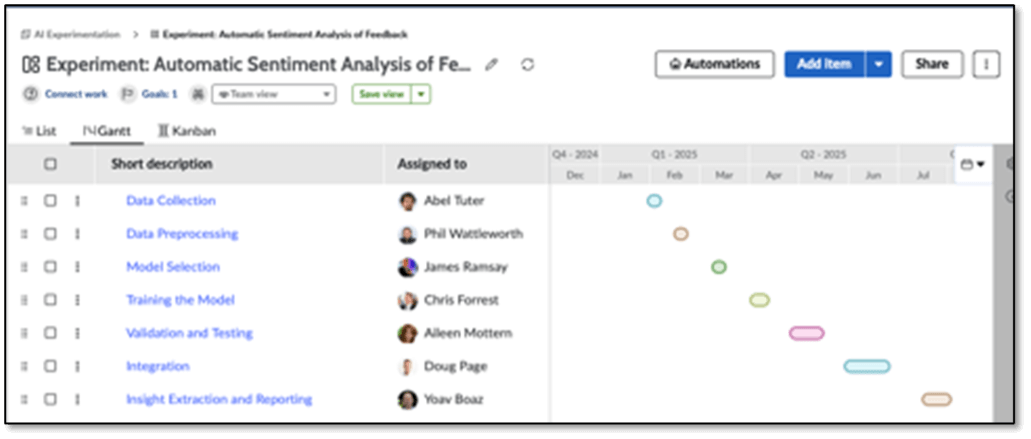
Omdia also reviewed the tasks associated with multiple AI projects assigned by ServiceNow AI Control Tower (see Figure 7). Because ServiceNow Control Tower maintains these task lists, organizations enforce accountability, along with validating that the project’s outputs align with the agreed-upon objectives and meet stakeholder needs.
Figure 7. Managing Tasks and Assigned Owners
Source: Omdia

Why This Matters

While organizations are eager to implement AI initiatives, critical steps can be overlooked, resulting in suboptimal results. Fostering effective collaboration requires proper task assignments and approvals that must be executed across a project’s lifecycle.

Omdia validated that ServiceNow AI Control Tower fosters collaboration across functions involved in AI projects. When a new project is uploaded or onboarded to Service AI Control Tower, we observed how the solution automatically assigns tasks and approvals associated with the Assess, Build and Test, and Deploy project phases using playbooks. By using ServiceNow AI Control Tower, organizations ensure that accountability is in place, increasing the chances of project success.

Decreasing Business Risk With Governance and Controls

To minimize compliance and security risk, ServiceNow AI Control Tower identifies risks associated with an AI project before it is built and deployed at the system, model, and dataset levels. ServiceNow AI Control Tower also enables ongoing governance so that organizations remain accountable for operating responsible AI.

Omdia Analysis

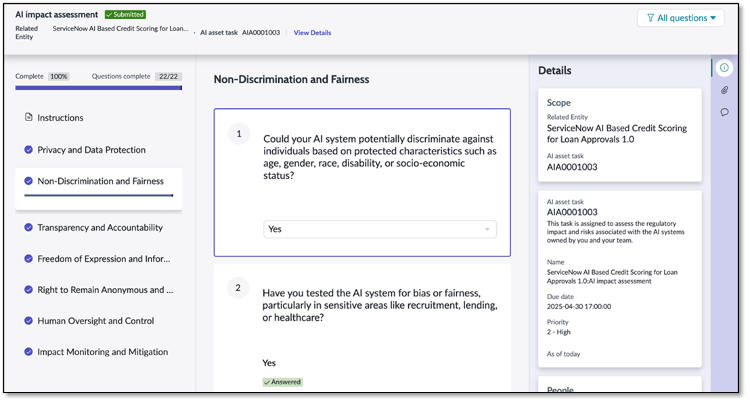
Once a proposed AI project is uploaded, ServiceNow assigns the business owner the task of submitting an “AI impact assessment” form (see Figure 8). Questions assess areas of potential risk, such as privacy and data protection, non-discrimination and fairness, transparency and accountability, and human oversight and control.
Figure 8. Completing Online AI Impact Assessment Form
Source: Omdia

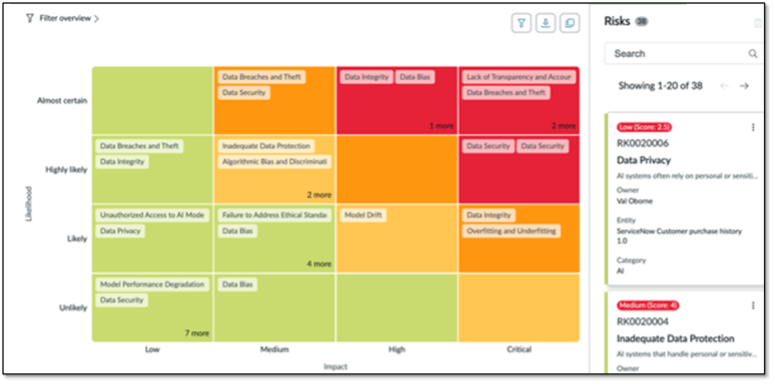
Using the responses entered into the form, ServiceNow AI Control Tower generated business risks that the AI project presents along with the likelihood that the risk will emerge (see Figure 9). Examples included privacy loss, data bias, reputational damage, and model poisoning. The heatmap view can help organizations prioritize those risks to address them based on the likelihood that the risk will emerge and the overall impact of addressing a risk factor on the success of the AI project.
Figure 9. Identifying Risks to be Addressed in AI Project
Source: Omdia

By assessing any compliance and security risk before any AI project’s “Build and Test” phase, ServiceNow AI Control Tower emphasizes the importance of deploying responsible AI. As we observed, the potential risk presented by the systems, models, and data to be used in this AI project is reviewed and clarified.
Omdia should also note how organizations can realize value with ServiceNow AI Control Tower before beginning a project by recognizing potential risk of AI assets. To ensure compliance, organizations would typically need to learn the relevant frameworks and regulations before applying them. Manually driven reviews and inspections would then be conducted for gauging asset risk. On the other hand, ServiceNow AI Control Tower can automatically assess risk using inputs gathered when onboarding the project. This also informs how risk of individual AI assets, if used across multiple projects, could potentially spread.
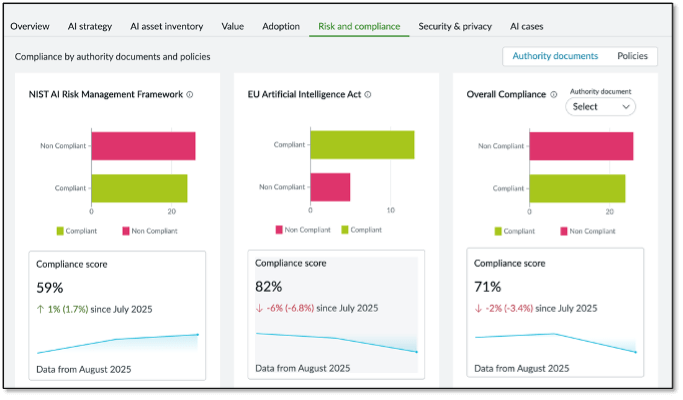
ServiceNow AI Control Tower can also assess risk throughout the project’s lifecycle. Omdia saw how risk is continuously monitored across all systems, models, and datasets, as well as project compliance against selected frameworks and regulations (see Figure 10). Tracking compliance against NIST AI Risk Management Framework and EU AI Act is supported out of the box. Organizations can also upload other frameworks.
Figure 10. Continuous Monitoring of Compliance Across AI Inventory and Projects
Source: Omdia

Why This Matters

Governance and control must remain top of mind as AI projects are put into production. It is imperative for organizations to become stewards of responsible AI that builds trust with end users, thus encouraging adoption and usage.

Omdia validated that ServiceNow AI Control Tower reinforces the proper governance and control over AI projects so that valid results that can be trusted are produced. We observed that the solution ensures that governance and control is in place for an AI project throughout its lifecycle. From project conception, ServiceNow identifies all possible risks, the likelihood of risk occurrence, and the impact of those risks within and across AI initiatives.

Visualizing the Value Gained From AI initiatives

While organizations accelerate their efforts to deploy AI, quantifying the value delivered might not be fully considered once projects are in production. ServiceNow AI Control Tower enables organizations to track detailed metrics and adoption rates that show the value delivered, providing evidence of how effective AI projects are in achieving strategic objectives and, ultimately, whether projects are worthy of future investment.

Omdia Analysis

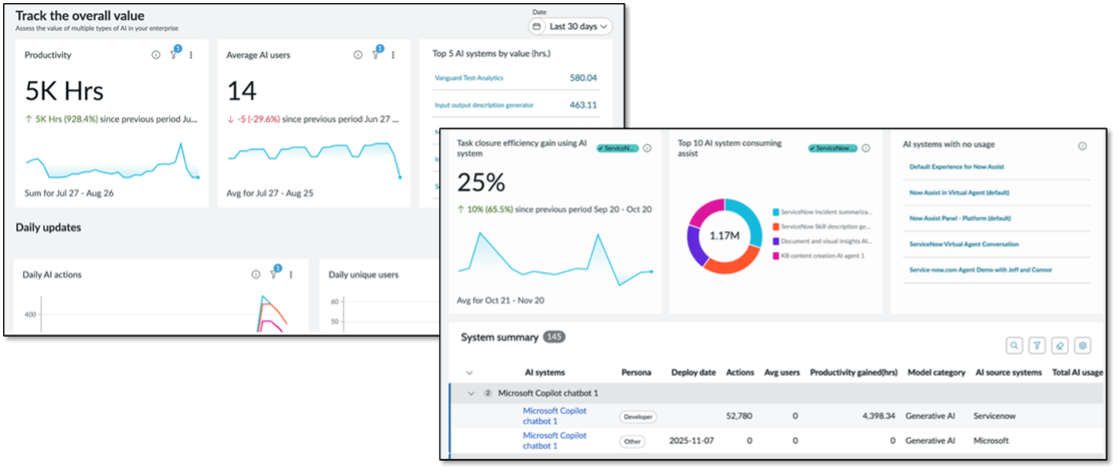
Omdia navigated to the “Value” tab that displayed specific metrics revealing the overall value delivered across all AI initiatives, based on a selected time period (see top left of Figure 11). Metrics included productivity, average number of AI users across all projects, daily AI actions taken (e.g., agent emailed information in response to request, get new skill details), and daily unique users. We also observed how we could drill down into any metric or system to view more detail). Organizations can define other metrics when applicable.
Figure 11. Tracking Top Level and Summary Value Metrics
Source: Omdia

Contributing to the calculation of summary value metrics were user engagement metrics that quantified overall AI adoption, such as total AI actions completed, average daily users engaging with AI, average feedback score, and daily unique AI users (see bottom right of Figure 11).
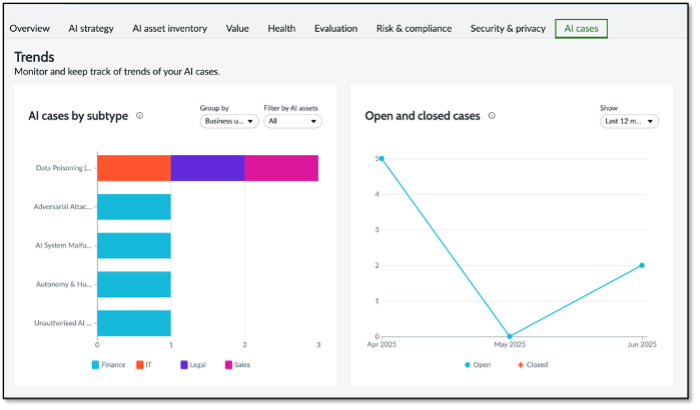
Issues are bound to occur when AI projects are in use; resolving these issues will only maximize the value extracted. With ServiceNow AI Control Tower, organizations can track the number and type of AI cases encountered, such as bias displayed and unexpected answers generated (see Figure 12). Tracking these cases can also support continuous improvement as organizations deploy more AI projects.
Figure 12. Tracking AI Cases

Source: Omdia

Why This Matters

Extracting maximum value from AI initiatives does not stop after deployment. Organizations need to monitor usage and adoption as well as track and resolve issues that arise. This calls for continuous visibility into the performance of AI projects operating in the field.

Omdia validated that ServiceNow AI Control Tower provides the ongoing visibility organizations need to track the value delivered by AI projects when deployed. We noted the variety of summary and detailed metrics tracked by ServiceNow to illustrate an AI project’s success, such as increased productivity measured by hours saved and average number of daily users. Omdia also observed that ServiceNow AI Control Tower can track AI cases to be resolved, which supports an organization’s effort to continuously improve both current and future AI projects.

Conclusion

Numerous organizations are bullish about AI’s potential to achieve strategic business objectives. Omdia research found that 86% of respondents are planning to invest $1 million or more over the next two years to support AI initiatives. Yet, 32% of organizations cited high implementation costs as a top challenge they encountered while implementing AI.
To justify these investments and the costs incurred, organizations need to demonstrate the business value derived from AI once deployed. While selecting the right use case impacts how much value can actually be realized, maximizing this value requires meticulous tracking and monitoring of AI projects against specific business objectives, ensuring project completion without overlooking critical steps, instilling the proper AI governance and control, and resolving issues that can impact the effectiveness of an organization’s AI.
ServiceNow AI Control Tower is designed to help organizations gain the most value from their AI initiatives by implementing the workflows, processes, and controls needed to bring AI projects to life. Using ServiceNow’s CMDB, the ServiceNow AI Control Tower creates an AI asset inventory that supports the breadth and depth of visibility that organizations need to deploy, operate, and monitor their AI projects. Once a project is uploaded or onboarded into ServiceNow AI Control Tower, organizations can tie it to specific business objectives to quantify the business impact. ServiceNow AI Control Tower also applies the workflows and processes required to complete an AI project, encompassing both task assignments and required approvals. With ServiceNow AI Control Tower, organizations gain overall control and visibility across all AI initiatives.
Throughout our evaluation, Omdia validated that ServiceNow AI Control Tower can help organizations increase the chances of success for AI projects by:
• Formally aligning specific business objectives to AI projects to demonstrate the value delivered using clearly defined targets.
• Fostering the necessary collaboration via automatic application and execution of workflows across different functions.
• Implementing the necessary governance and control from the beginning of an AI project and throughout its lifecycle.
• Providing the visibility organizations need to identify high-priority and high-impact issues that can affect AI project success.
As organizations ramp up their AI investments, Omdia believes that ServiceNow AI Control Tower provides the comprehensive solution needed to manage and monitor new and ongoing AI initiatives without losing sight of the business value and compliance organizations need to monitor. We believe that organizations should closely examine how ServiceNow AI Control Tower can maximize the success of their AI initiatives.

DOWNLOAD REPORT

Copyright notice and disclaimer

The Omdia research, data, and information referenced herein (the “Omdia Materials”) are the copyrighted property of TechTarget, Inc. and its subsidiaries or affiliates (together “Informa TechTarget”) or its third-party data providers and represent data, research, opinions, or viewpoints published by Informa TechTarget and are not representations of fact.

The Omdia Materials reflect information and opinions from the original publication date and not from the date of this document. The information and opinions expressed in the Omdia Materials are subject to change without notice, and Informa TechTarget does not have any duty or responsibility to update the Omdia Materials or this publication as a result.

Omdia Materials are delivered on an “as-is” and “as-available” basis. No representation or warranty, express or implied, is made as to the fairness, accuracy, completeness, or correctness of the information, opinions, and conclusions contained in Omdia Materials.

To the maximum extent permitted by law, Informa TechTarget and its affiliates, officers, directors, employees, agents, and third-party data providers disclaim any liability (including, without limitation, any liability arising from fault or negligence) as to the accuracy or completeness or use of the Omdia Materials. Informa TechTarget will not, under any circumstance whatsoever, be liable for any trading, investment, commercial, or other decisions based on or made in reliance of the Omdia Materials.

© {{CurrentYear}} TechTarget, Inc. d/b/a Informa TechTarget. All rights reserved. The Informa TechTarget name and logo are subject to license. All other logos are trademarks of their respective owners. Informa TechTarget reserves the right to make changes in specifications and other information contained in this document without prior notice.