TECHNICAL VALIDATION
ServiceNow Autonomous Service Operations
Begin Your Journey to Self-healing IT
By Justin Boyer, Senior Validation Analyst
Omdia
JANUARY 2026
Introduction
Background
Figure 1. Organizations See Many Benefits to Using AI Agents

Source: Omdia
.png?v=02182026143315)
ServiceNow Autonomous Service Operations
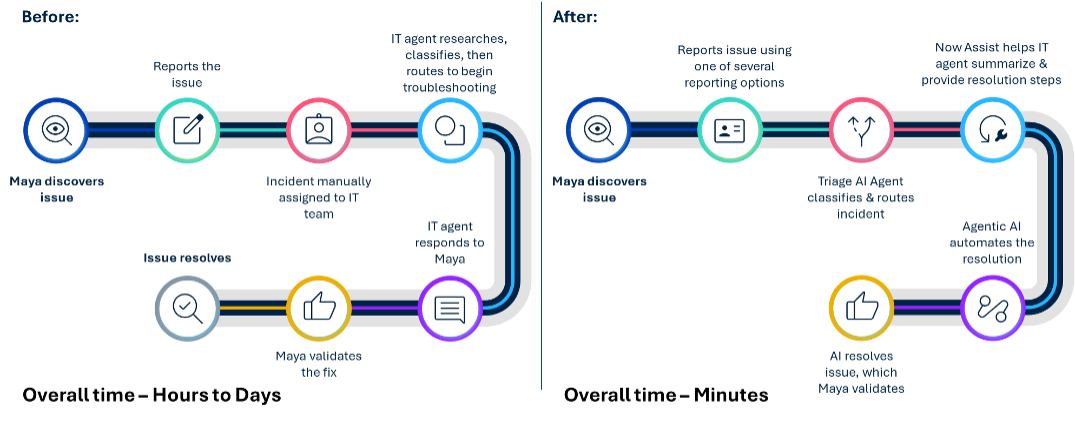
Although agentic AI can be applied to many domains, IT service operations, the intersection of IT Service Management (ITSM) and IT Operations Management (ITOM) functions, is one where AI can have a transformational impact. ServiceNow has developed its solutions to take advantage of these benefits, such as improving efficiency, reducing manual workloads, and leveraging data-driven insights while improving customer experience. ServiceNow uses agentic AI to automate ITSM and ITOM, using such agents to triage and resolve incidents faster, increase productivity and accuracy, and save time. ServiceNow refers to this capability as Autonomous Service Operations.
Figure 2. Before and After ServiceNow Autonomous Service Operations
Source: ServiceNow and Omdia

Omdia Technical Validation
IT Operations teams that embrace the power of AI agents can realize several key benefits, including increased productivity, reduced costs, and improved customer experience. Omdia explored how ServiceNow brings these benefits to bear for organizations of all sizes.
Increase IT Productivity and Reduce Costs
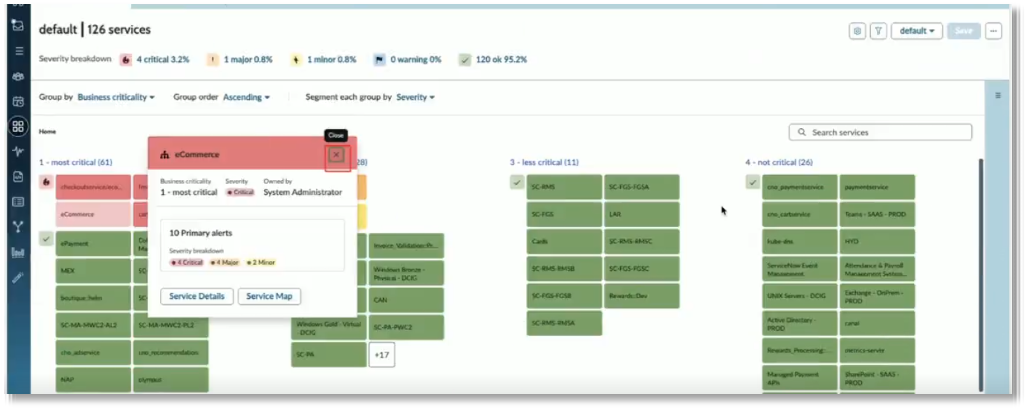
Figure 3. Service Operations Workspace
Source: Omdia
Why This Matters
IT service management and operations is an essential business function, but many challenges can make it costly and burdensome. According to research conducted by Enterprise Strategy Group (now Omdia), 71% of survey respondents indicated that identifying root cause across teams is at least somewhat burdensome and complex, with another 71% indicating that correlating metrics across tools is also burdensome. These factors increase complexity and cost for IT operations and other teams that depend on strong IT service management, such as change management, compliance, and security teams.
Omdia validated how ServiceNow’s Autonomous Service Operations solution helps organizations strategically use AI agents to save time, effort, and cost. By utilizing the strong CMDB that underlies ServiceNow’s offerings, AI agents can quickly scan multiple data sources to find root causes and recommend remediation strategies. Humans are kept in the loop at every step but no longer have to dig into multiple tools to find problems. ServiceNow surfaces service data across IT silos and helps to build a unified view of IT services and highlight where there might be production problems, helping IT teams to proactively fix problems faster than before.
Using ServiceNow, organizations can use AI to quickly gather information, understand context, and find and fix troublesome issues with efficiency and speed. Doing so saves time and costs while building a strong, cohesive foundation for IT operations to better serve the organization.
Improve Employee Experience and Satisfaction
Figure 4. Employee Center
Source: Omdia
Increase Service Resilience and Business Agility
Figure 5. Now Assist Generative AI Helping to Diagnose Service Interruptions
Source: Omdia
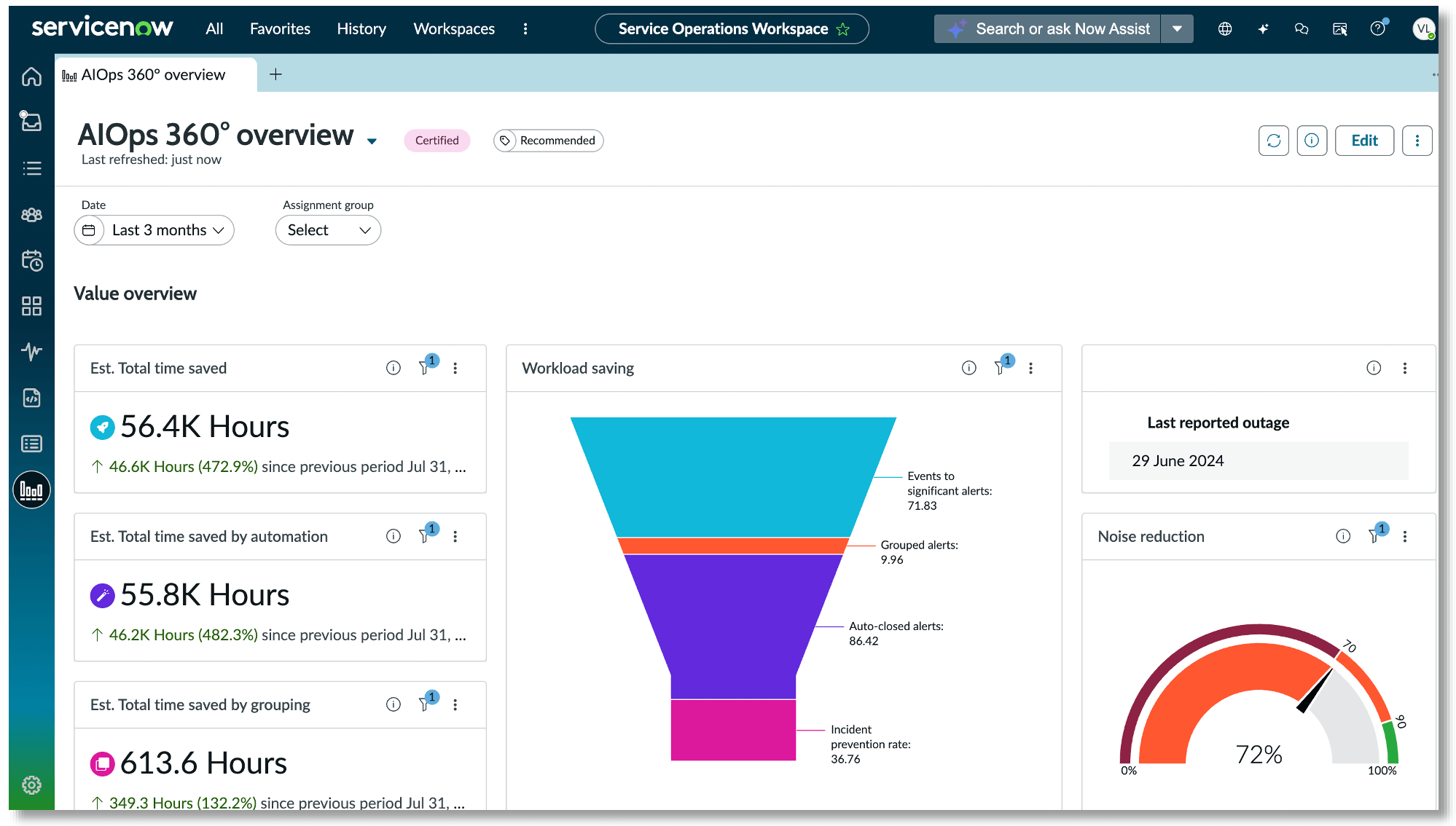
Figure 6. AIOps Overview Dashboard
Source: Omdia
Why This Matters
IT operations teams have to deal with more complexity in addition to increasing expectations to keep up with new technologies and resolve issues quickly. According to Enterprise Strategy Group (now Omdia) research, 95% of survey respondents indicated that their IT operations team is expected to operate at least 25% faster than they did three years ago, with 54% of these organizations reporting that they need to operate at least 50% faster than three years ago and another 19% indicating that they’re expected to act at least twice as fast when compared to three years ago. Expectations for agility and responsiveness continue to rise, which is taking a toll on IT operations teams.
Omdia validated that ServiceNow can help organizations increase service resiliency, support business agility, and continue to respond to alerts and tickets with speed and accuracy. ServiceNow’s service-focused CMDB integrates with monitoring tools throughout the environment to give IT operators a clear view of root causes along with the context necessary to plan remediations. The AIOps 360 Overview provides a clear picture of how ServiceNow has helped organizations save time, reduce noise, and resolve incidents, showing a clear ROI from using ServiceNow’s AIOps capabilities.
Conclusion


DOWNLOAD REPORT
Copyright notice and disclaimer
The Omdia research, data, and information referenced herein (the “Omdia Materials”) are the copyrighted property of TechTarget, Inc. and its subsidiaries or affiliates (together “Informa TechTarget”) or its third-party data providers and represent data, research, opinions, or viewpoints published by Informa TechTarget and are not representations of fact.
The Omdia Materials reflect information and opinions from the original publication date and not from the date of this document. The information and opinions expressed in the Omdia Materials are subject to change without notice, and Informa TechTarget does not have any duty or responsibility to update the Omdia Materials or this publication as a result.
Omdia Materials are delivered on an “as-is” and “as-available” basis. No representation or warranty, express or implied, is made as to the fairness, accuracy, completeness, or correctness of the information, opinions, and conclusions contained in Omdia Materials.
To the maximum extent permitted by law, Informa TechTarget and its affiliates, officers, directors, employees, agents, and third-party data providers disclaim any liability (including, without limitation, any liability arising from fault or negligence) as to the accuracy or completeness or use of the Omdia Materials. Informa TechTarget will not, under any circumstance whatsoever, be liable for any trading, investment, commercial, or other decisions based on or made in reliance of the Omdia Materials.
© {{CurrentYear}} TechTarget, Inc. d/b/a Informa TechTarget. All rights reserved. The Informa TechTarget name and logo are subject to license. All other logos are trademarks of their respective owners. Informa TechTarget reserves the right to make changes in specifications and other information contained in this document without prior notice.