Transforming
Security Operations
for the AI Era
Executive overview
The cybersecurity landscape is undergoing a broad transformation driven by artificial intelligence (AI). AI-enabled adversaries now operate with unprecedented speed and sophistication, executing automated reconnaissance, deploying novel attacks at scale, and exploiting vulnerabilities across the entire attack surface faster than ever before. This adversarial AI is democratizing cybercrime, lowering the barrier to entry, and enabling less-sophisticated actors to launch fast, successful attacks. The stark reality is that traditional manual security operations (SecOps) can no longer keep pace with the sheer volume and velocity of modern threats.
Beyond automating manual activities, the speed of AI-driven attack execution is quickly shrinking the window for reactive security strategies, precipitating a need to increase proactive, risk, and exposure management strategies within SecOps functions.
As cybersecurity teams attempt to scale and extend existing systems, the high cost of security data access and storage further creates artificial barriers to fighting back, forcing security architects to compromise the data needed to enable a more rapid, more comprehensive understanding and response to attacks. Tacked on AI-enabled capabilities further increase cost, as AI token operations add an entirely new cost vector.
Architecting for agentic SOC
Security teams have more data, more alerts, and fewer people than ever. That’s not new; it’s been the story for a decade. What has changed is that AI has reached the point where it can meaningfully help with the work, not just surface more information for humans to process.
The question isn’t whether AI belongs in SecOps; every serious buyer already assumes it does. The question is: What does a well-designed AI-powered security experience actually look like?
Change is needed. Cybersecurity program strategies must fight back with more integrated, machine-driven capabilities able to scale without compromising security outcomes and security program affordability.

The path to autonomous SecOps
While industry consensus supports the transition toward more autonomous SecOps, the journey requires careful navigation. Autonomy without appropriate oversight introduces significant risk, and organizations’ risk tolerance levels vary considerably. There is no universally accepted approach to SOC autonomy; instead, organizations need the flexibility to architect and customize their human-in-the-loop and human-on-the-loop strategies, determining where, when, why, and how to deploy fully autonomous versus human-assisted activities and responses. The solution lies in a continuum of autonomy options that enable organizations to establish the optimal balance of machine-human collaboration and an ability to adapt this balance as their capabilities and confidence mature over time.
Navigating rapid AI innovation
The pace of AI advancement presents both tremendous opportunity and operational challenge. While breakthrough innovations are emerging at an accelerating rate, security teams risk entering a perpetual cycle of technology replacement if they prematurely adopt today’s AI solutions without architecting for tomorrow’s innovations. Lean security organizations cannot afford the disruption and resource drain of continuous rip-and-replace cycles to access the next generation of AI capabilities.
A new platform paradigm for agentic security
Traditional security platforms have successfully bundled and integrated multiple security solutions, simplifying operations while enhancing threat detection and response efficacy. However, these first-generation platforms were designed to support human-centric activities, workflows, and decision-making processes. As SecOps processes increasingly leverage agentic AI to operate and collaborate more autonomously, legacy platforms reveal critical gaps in their ability to execute, orchestrate, manage, customize, and scale the rapidly proliferating ecosystem of AI agents required for modern defense.
Furthermore, first-generation platforms operate on economic models that are rapidly becoming unaffordable as growing data and agentic operating infrastructure requirements render these models obsolete.
This White Paper presents a comprehensive blueprint for an agentic SecOps platform: a next-generation architecture that empowers security teams to harness current AI innovations while building a scalable, extensible foundation for the future. This platform approach enables organizations to precisely control their desired level of autonomy today and evolve it over time, while positioning their environment to seamlessly adopt emerging AI advancements as they materialize. By bridging the gap between today’s AI capabilities and tomorrow’s innovations, this new platform paradigm ensures security teams can defend at machine speed without sacrificing strategic flexibility or operational control.

A blueprint for agentic SecOps
The evolution from deterministic automation to AI represents a fundamental architectural shift in SecOps. Traditional security platforms (see Figure 1 on the following page) have relied on rule-based, deterministic functions—predefined workflows that execute predictable actions in response to known conditions. While effective within their design parameters, these systems lack the adaptive intelligence needed to address the dynamic, unpredictable nature of modern cyberthreats.
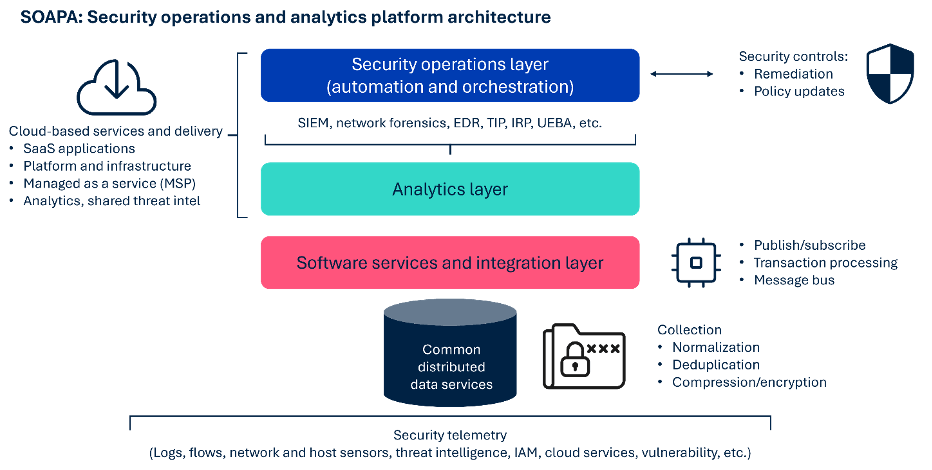
While many of the foundational components of the operational stack are still needed to support agentic SecOps, their operating dynamics are quite different, requiring significant architectural change or wholesale replacement. In the traditional model, the common distributed data services layer is still foundational, yet its operating requirements are vastly different in an agentic operating model, as request speeds and volumes increase exponentially.
Agentic SecOps: A new operating model
Agentic SecOps introduces a fundamentally different operating model. Powered by AI, these systems employ non-deterministic reasoning to interpret novel signals, contextualize emerging threats, and dynamically determine appropriate response actions without rigid pre-programming. This shift from “if-then” logic to intelligent decision-making enables SecOps to operate at the speed and scale demanded by today’s threat landscape.
However, this transformation necessitates a corresponding evolution in platform architecture. An agentic SecOps platform must possess capabilities that extend far beyond those of its predecessors. It must dynamically invoke variable sets of functions and actions in response to unprecedented events, adapt its behavior based on contextual understanding, and orchestrate complex multi-step responses across diverse security tools and data sources. Critically, it must accomplish this while maintaining complete transparency into AI-driven decisions, enabling appropriate human oversight, and providing granular control and feedback governing autonomous operations to align with organizational risk tolerance and compliance requirements.
As shown in Figure 2, a new operating layer has been added to control, manage, operate, and integrate the agentic operating model. Several traditional architectural components still exist, but their operating requirements have changed.
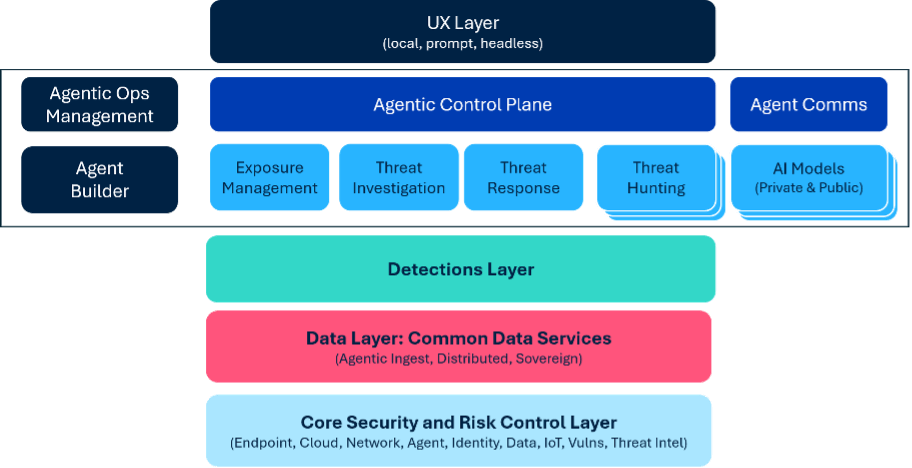
This expanded agentic SecOps platform architecture is designed to deliver AI-driven autonomy while preserving the governance, visibility, and control that enterprise security demands. This architecture serves as both a technical roadmap and a strategic guide for organizations seeking to transform their SecOps for the age of intelligent automation.
The data layer: Common data services
Telemetry is the foundation of SecOps, providing visibility into every activity, exposure, and event for every IT asset. As an industry, security teams have amassed terabytes of data used to detect, investigate, and stop attacks early in the attack chain. Detecting potentially risky, suspicious, or malicious activity has increasingly become a machine-led function. However, the investigation, determination, and response have long been a relatively slow, manual, human-led function. Agentic AI changes this model, enabling machines to do much of this work and exponentially increasing the velocity and scalability of investigation, response, and exposure management.
As the security dataset fuels AI models, agentic reasoning becomes critical to enabling a more autonomous SecOps function. Retrieval quality directly affects the quality of an agent’s reasoning and decisions, since agents can only reason over what they retrieve. Data search and retrieval quality, therefore, becomes a key architectural consideration, favoring solutions that offer hybrid search capabilities combining semantic, lexical, and other retrieval types.
To power a more automated SecOps function, the data layer must be able to operate at a very different scale, continuously serving tens of thousands of data requests from the many AI agents involved in threat and exposure investigation and mitigation. In addition to this massive increase in scale, the security dataset is also growing exponentially, requiring new models for data pipeline management, storage, and access.
The modern security data layer must further expand to support a distributed dataset, data sovereignty requirements, flexible data deployment models (cloud, on-premises, hybrid), rapid onboarding of new data types and providers, highly dynamic datasets (risk and exposure data, etc.), and data ingestion from an array of other security tools and sources.
There is also an opportunity to leverage this data layer to fuel observability and AI models, further reducing operational data management costs while aligning functional visibility and outcomes.
And critically, this data layer must scale without forcing security teams to constrain what data is used, based on the escalating costs of data storage and access. When the same telemetry can be utilized in support of security, observability, and risk functions, further economies of scale can be realized, reducing the cost of data storage and the hygiene management of the dataset.
The agentic layer
The agentic layer comprises a control plane, many skills, many agents, and the ability for agents and skills to communicate with other agents and skills. This critical operating layer powers the native platform’s agentic capabilities and is the same layer that will enable local AI engineering teams to build RAG pipelines, semantic search, and custom AI applications. This model compounds security platform investments by providing the operating infrastructure for customized extensions to the platform.
Skills
Skills are units of work. Examples include triage, investigation, reverse engineering, entity analytics, threat response, threat hunting, and exposure management. Skills typically depend on multiple agents but can also call on or depend on other skills to carry out units of work.
For example, triage calls reverse engineering when it encounters a suspicious binary. Threat hunting calls entity analytics for behavioral context. Triage outcomes can feed back to detection engineering, which can then tune rules and automatically create exceptions. Entity analytics can act as a shared context layer that any skill can query. As a result, the system becomes smarter over time as skills feed into one another.
Agents
Agents are discrete units of data, processing, and AI functions. For comparison, agents are like microservices—and skills like containers—that carry out specific functions and tasks.
Agentic operations
Likewise, the control plane is similar to the skills orchestration layer. This module orchestrates all security functions, dependencies, relationships, and actions required to carry out the many SecOps functions. Orchestration includes both skills and agent orchestration.
Agent communications
The Model Context Protocol (MCP) is becoming the standard way AI applications connect to external tools and data. Claude, VS Code, Cursor, Windsurf, and a growing list of AI clients all support MCP.
Agent comms supports bi-directional agent communications, both internally and externally, enabling the use and/or consumption of other agents of value, and facilitates all aspects of the SecOps process, enabling broad use and integration with other operating components within the security tech-stack.
Some examples include:
- When an analyst triages an alert in Claude, that triage action can be written back to the agentic platform.
- When a case is created from within VS Code, it can appear in another visualization tool.
- A detection rule tuned in Cursor can be deployed through the same detection engine in the agentic platform.
The MCP app, therefore, becomes a window into the agentic platform, rather than a fork of it.
Agent builder
Most organizations have a growing, configurable set of capabilities, and using an agent builder can help them create and orchestrate AI agents and skills inside the platform. This model enables local creation and customization of agents to support new use cases, without waiting on the platform provider. Skills, MCP apps, and tools can be added continuously, without waiting for a platform release. As new AI advancements emerge, security teams can realize value quickly.
Agentic operations management
This function enables the creation and assembly of agents, skills, skill-to-skill orchestration, and the ability for the operations layer to invoke skills as needed to complete investigations and response activities to mitigate a threat.
Detection and analysis layer
Detection and analysis combine a rich set of detections, informed by threat intelligence. This layer aggregates, correlates, and analyzes signals across the operating estate searching for known and unknown threats, along with known exposures and the context around them. Continuous, agentic analysis of intelligence fuels automated detection engineering and refinement, while continuous exposure management provides context enabling higher-risk threats to be prioritized. This core function takes on a new dynamic in the AI era, as attack speed leaves little time for delays in response decision-making. Agentic automated response mechanisms ensure imminent threats are contained quickly.
User interaction layer
Not every security practitioner works all day inside the SIEM. Detection engineers spend significant time in code editors. Incident responders bounce between Slack, ticketing systems, and AI assistants. Threat hunters use notebooks and query tools. Security leadership uses whatever is fastest to get an answer.
As SecOps moves to a more autonomous operating model, the UX layer must, therefore, transition from a static, vendor-defined user operation model to a flexible, user-defined interaction model. For some, this will include the ability to operate within a platform-specific user interface, but for others who desire prompt-based interactions or the ability to interact through other systems and tools in use, this will allow for headless or prompt-based interactions. This flexible model extends to all platform functions, including oversight, investigation support, exposure management, and all other platform functions required to manage the agentic control plane.
Core security and risk controls
This layer includes both reactive (Endpoint, Cloud, Identity, Network, IoT, AI, etc.) and proactive (assets, risk/exposure, threat intel, policies, dependencies, etc.) functions. When posture, identity, and detection share a single data foundation, an analyst investigating an active alert sees asset context, identity risk, and posture exposures within a common operating environment. Security teams no longer need to reconcile two data models or pivot between tools. This integrated platform model enables exposure and detection to inform each other, speeding up risk and threat mitigation.
Conversely, when siloed posture, identity, and detection security tools are used, every tool boundary creates a delay. Every integration is a potential point of failure during an active incident.
As the speed of attack execution nears zero, reactive security strategies can no longer keep up, driving an imperative to converge proactive and reactive strategies within a common platform and dataset.

The agentic SecOps experience
As security teams embrace more autonomous operations, agentic systems will enable analysts to operate in new models, focusing on higher-value functions, while machines carry out more manual, tedious tasks typically required to complete traditional security activities.
When an analyst asks its AI client a security question, it doesn’t just get text back. It receives interactive applications rendered inline in the conversation. The following are four examples of agentic-enabled activities, describing workflows when an analyst works through their preferred AI client to carry out activities from within an agentic SecOps platform.
Alert triage
The analyst asks to triage alerts. The AI responds with a text analysis alongside a full triage dashboard: alerts grouped by host, severity indicators, MITRE ATT&CK tags, and AI verdict cards classifying each group as malicious, suspicious, or benign. The analyst can then click any alert for full metadata, process tree visualization, and network events. Similarly, the analyst can one-click to classify and auto-create a case.
Incident investigation and response
Three alerts arrive across different systems within seconds of each other. The agentic platform correlates them into a single attack signal, runs a hypothesis-driven investigation, builds the full entity context, and stages a response plan. The analyst receives one notification—case ready, high confidence, or response staged—then reviews the case and approves the response before it executes. The total time from first alert to approved response is less than 10 minutes.
The platform handles investigation. The analyst handles judgment. The attacker moves in seconds. The defender responds in minutes. That gap is the entire game.
Threat hunting
The analyst describes a hypothesis. The AI writes and executes a query, and the results render in an interactive workbench. Entity names in the results—such as hosts, users, IPs, processes—are all clickable. The analyst can click an entity name to add it to an investigation graph. The graph can expand progressively, with each expansion running real queries against the dataset. Analysts can also hover over a node to highlight its connections or click it to open a detail panel that displays the real data.
Detection rules
Rules render with query blocks, severity indicators, MITRE tags, and validation panels. The analyst can browse, search, and toggle rules without leaving the conversation.

Platform economics
The operational burdens the security industry has imposed on SOCs for years—standing up and managing separate SOAR/SIEM/TIP/*SPM, leaving endpoints uncovered because of per-device fees, getting locked into a vendor’s choice of LLM with no transparency—all negatively impact security outcomes and program efficiency.
Despite the widely recognized value of the growing volume of telemetry, security teams have been forced to constrain access and retention based on high-cost solution operating models. In volume-limited deployments, operators face a practical choice between comprehensive log ingestion and cost. The typical response is to filter aggressively at the collection layer, discarding log sources or event types deemed low priority. This filtering degrades correlation quality in ways that are not always predictable at collection time; the relevance of a log source often becomes apparent only during an incident investigation, not during capacity planning.
Removing volume limits changes the deployment calculus. Operators can ingest all available log sources without filtering for cost reasons, feed the full event stream, and maintain complete historical records for forensic investigation without managing tiered storage to control costs.
AI token operations costs are quickly adding a new affordability vector, forcing security leaders to further limit potential program accelerators.
Introducing Elastic Agentic Security Operations

Humans on top
Unlike a fully autonomous SOC solution that entirely removes the human from the process, Elastic’s Agentic Security Operations platform moves the human to the top of the process. The platform investigates, correlates, and builds the response plan. The analyst reads, judges, and approves the plan. The platform then performs automated actions to mitigate risk, threats, and attacks. The goal is to match the speed of the attacker without removing human judgment from decisions that require it. This architecture—human-on-the-loop rather than human-in-the-loop—is what separates an agentic SecOps platform from both the legacy model and the theoretical fully autonomous SOC model.
Elastic's model-agnostic architecture gives customers the flexibility to use Elastic's managed inference service or bring the model of their choice, including models from vendors like OpenAI, Anthropic, and Google, as well as on-premises open source models. It features the Elastic Agent Builder for orchestration and uses Jina AI multimodal models for proprietary retrieval advantages across languages and unstructured data.
The next evolution beyond SIEM and XDR
While Elastic Agentic Security Operations provides world-class SIEM and XDR capabilities, it functions as a complete agentic security operations platform, unifying risk and threat detection, investigation, and response in one place, without the fragmentation and fees of legacy tools.
The same Elastic platform security teams use for detection is the platform AI engineering teams use to build agents, semantic search, and AI applications. That shared foundation means the AI reasoning in the SOC is grounded in real data, rather than operating on a separate layer. Elastic further provides hybrid search capabilities, blending two or more search methods (e.g., lexical, semantic, etc.) into a single ranked list to improve relevance and recall. As modern AI processes diverse modalities, text, images, audio, logs, and more, relevance is becoming more critical than ever.1
Removing traditional security ‘taxes’
The security industry has added barriers where it should have removed them:
 The endpoint tax: Per-device fees force coverage decisions that should never be a budget call. Elastic is priced on the compute and storage an organization uses, not per endpoint, so coverage decisions are never an economic decision.
 The automation tax: A separate SOAR means brittle, deterministic workflows that can’t adapt to today’s threats. Native automation is built into the Elastic Agentic Security Operations platform, so there’s no separate SOAR to buy, integrate, or maintain.
 The AI black-box tax: Vendor-mandated models with no transparency mean teams can’t validate the decisions being made on their behalf. Lack of visibility can further introduce risk, post-incident, when it comes to cyber risk insurance. Explainability is paramount when assessing root cause and liability in an incident. The Elastic platform is model-agnostic, with full visibility into every AI decision, including prompts, queries, and reasoning.
 The data tax: Rehydration penalties on an organization’s own historical data create blind spots exactly when full context matters most. With Elastic, organizations can query years of archived data in place, in seconds, with no rehydration wait or penalty.
Roadmap: Open by design
Elastic is open by architecture. The platform ships with 1,900+ prebuilt rules and machine learning jobs mapped to MITRE ATT&CK, covering endpoint, identity, cloud, network, SaaS, and application scenarios. Elastic Security Labs Threat Command (Elastic’s threat intelligence group) maintains these continuously. Elastic’s open and customizable detection rules support community standards such as ECS and OCSF, are published on GitHub, and provide full transparency into the AI’s logic, sources, and path. This “no black boxes” approach ensures defenders maintain full control over their data and rules.
Conclusions
Security teams must transform operating models and infrastructure to defend against a rapidly growing, AI-enabled adversary. The speed and diversity of attack and attack execution mandate change, but change is risky for most. Every facet of the cybersecurity operating model is in question, as security solution providers race to deliver AI-enabled capabilities to support this change. Meanwhile, security architects face an even bigger challenge as they navigate a rapidly changing solution landscape fueled by a continuous stream of AI innovation.
Many security architects and leaders are already at a crossroads of incremental improvement or major transformation. With the risk that incremental improvements can create incremental technical debt, security leaders will quickly reach the limits of their operating systems and processes, forcing a crisis moment as the adversary outpaces security program capacity.
Omdia strongly recommends security organizations consider agentic security operations platforms from vendors like Elastic to accelerate core security capabilities, set their own level of autonomy across the SecOps lifecycle, and lay a scalable foundation that enables machine-speed defenses with continuous human oversight.
DOWNLOAD REPORT
Opens in a new window.
Omdia consulting
Omdia is a market-leading data, research, and consulting business focused on helping digital service providers, technology companies, and enterprise decision makers thrive in the connected digital economy. Through our global base of analysts, we offer expert analysis and strategic insight across the IT, telecoms, and media industries.
We create business advantage for our customers by providing actionable insight to support business planning, product development, and go-to-market initiatives.
Our unique combination of authoritative data, market analysis, and vertical industry expertise is designed to empower decision-making, helping our clients profit from new technologies and capitalize on evolving business models.
Omdia is part of Informa TechTarget, a B2B Materials information services business serving the technology, media, and telecoms sector. The Informa group is listed on the London Stock Exchange.
We hope that this analysis will help you make informed and imaginative business decisions. If you have further requirements, Omdia’s consulting team may be able to help your company identify future trends and opportunities.
Copyright notice and disclaimer
The Omdia research, data, and information referenced herein (the “Omdia Materials”) are the copyrighted property of TechTarget, Inc. and its subsidiaries or affiliates (together “Informa TechTarget”) or its third-party data providers and represent data, research, opinions, or viewpoints published by Informa TechTarget and are not representations of fact.
The Omdia Materials reflect information and opinions from the original publication date and not from the date of this document. The information and opinions expressed in the Omdia Materials are subject to change without notice, and Informa TechTarget does not have any duty or responsibility to update the Omdia Materials or this publication as a result.
Omdia Materials are delivered on an “as-is” and “as-available” basis. No representation or warranty, express or implied, is made as to the fairness, accuracy, completeness, or correctness of the information, opinions, and conclusions contained in Omdia Materials.
To the maximum extent permitted by law, Informa TechTarget and its affiliates, officers, directors, employees, agents, and third-party data providers disclaim any liability (including, without limitation, any liability arising from fault or negligence) as to the accuracy or completeness or use of the Omdia. Informa TechTarget will not, under any circumstance whatsoever, be liable for any trading, investment, commercial, or other decisions based on or made in reliance of the Omdia Materials.
1Source: Learn more at Elastic, “What is hybrid search?” https://www.elastic.co/what-is/hybrid-search
© {{CurrentYear}} TechTarget, Inc. d/b/a Informa TechTarget. All rights reserved. All other trademarks are the property of their respective owners.